
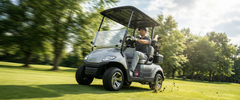
How to Make a Golf Cart Faster? Safe, Practical, and Legal Speed Upgrades
, 8 Tiempo mínimo de lectura

, 8 Tiempo mínimo de lectura
Most factory golf carts are built with one priority in mind: safety on the golf course. As a result, their top speed is usually limited to 12–15 mph. That’s perfectly fine for fairways—but frustrating for neighborhoods, farms, large properties, and worksites.
So the question many owners ask is simple:
“How can I make my golf cart faster without damaging it or breaking the law?”
This guide answers that question step by step. You’ll learn what truly affects golf cart speed, which upgrades actually work, and how to choose the right solution for your needs—all with safety and reliability in mind.
Manufacturers intentionally limit golf cart speed for safety and battery longevity. While this makes sense on a golf course, it often feels restrictive in real-world use.
Common reasons owners want more speed include:
Typical upgrade goals:
▷Before increasing speed, it’s essential to understand how speed is produced and which upgrades provide real value.
Golf cart speed is not controlled by a single part. It’s the result of an entire system working together.
|
Impact Level |
Component |
Why It Matters |
|
⭐⭐⭐⭐⭐ |
Battery voltage & power output |
Determines how much energy is available |
|
⭐⭐⭐⭐ |
Speed controller |
Limits how much power reaches the motor |
|
⭐⭐⭐ |
Motor RPM & design |
Converts power into motion |
|
⭐⭐ |
Tire size & gearing |
Affects ground speed |
|
⭐ |
Load & terrain |
Reduces real-world performance |
If one component is weak, the entire system is limited.
A golf cart functions as a complete electrical system. For example:
Balanced upgrades always outperform isolated changes.
Before spending money, ask yourself:
Is my golf cart already performing at its best?
These steps alone can restore lost speed:
Some carts allow limited speed increases through:
⚠ These changes should be done carefully—often by a professional—to avoid overheating or reliability issues.
If maintenance isn’t enough, the battery system is usually the best place to upgrade first.
Yes—when done correctly.
|
System Voltage |
Typical Result |
|
36V → 48V |
Noticeable speed & torque improvement |
|
48V → 72V |
Major performance gains (advanced setups) |
⚠ Motors and controllers must be compatible with higher voltage.
Compared to traditional lead-acid batteries, lithium (LiFePO4) batteries offer:
Table: Lead-Acid vs Lithium Performance
|
Feature |
Lead-Acid |
Lithium (LiFePO4) |
|
Weight |
Heavy |
Up to 60% lighter |
|
Voltage stability |
Drops under load |
Very stable |
|
Charging speed |
Slow |
Fast |
|
Lifespan |
300–500 cycles |
3000+ cycles |
For many 48V golf carts, a 51.2V LiFePO4 battery system is the ideal balance.
Example:
Sunrich Energy 51.2V 100Ah LiFePO4 Golf Cart Battery
Why it works well:
☞ For many owners, this single upgrade provides the best speed-to-cost improvement.
A higher-amp controller allows your cart to use available battery power more effectively.
Motor upgrades are best when:
⚠ High-speed motors may reduce low-speed torque. Choosing the wrong motor can hurt usability.
Larger tires can increase top speed by covering more distance per rotation. However:
✔Gear ratio changes can further enhance top-end speed but are best used as part of a complete performance system—not as standalone upgrades.
Before increasing speed, ask yourself:
Can my cart stop, turn, and remain stable at higher speeds?
Essential considerations:
Speed without control increases risk and reduces reliability.
Always check local regulations before upgrading.
Avoiding these mistakes saves time, money, and frustration.
The smartest approach is progressive and balanced:
1. Optimize maintenance and efficiency
2. Upgrade the battery system
3. Upgrade the controller if needed
4. Upgrade the motor only when necessary
A faster golf cart isn’t just quicker—it’s more capable, more efficient, and more enjoyable to drive.
☛ Ready to Improve Your Golf Cart’s Performance?
If you’re considering a battery upgrade, explore reliable lithium options designed specifically for golf carts.
The right upgrade can deliver more speed, longer range, and better overall performance—without sacrificing safety.

$379.99 - $1,443.99

$369.99 - $1,405.99


