
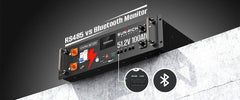
RS485 vs Bluetooth Monitor: Which Is Right for Your Application?
, 7 Tiempo mínimo de lectura

, 7 Tiempo mínimo de lectura
When you're monitoring a power system—whether it’s an off-grid solar setup, an RV electrical system, a marine battery bank, or an industrial automation network—the communication interface you choose matters. It impacts reliability, distance, energy efficiency, installation difficulty, and overall user experience.
Many devices today support either RS485 or Bluetooth for data monitoring.
But which one is better for your specific application?
Before you decide, here’s a complete, practical comparison based on real-world use cases.
RS485 is an industrial-grade differential serial communication standard used for reliable, long-distance data transmission.
RS485 is the backbone of many professional systems:
RS485 defines the physical electrical layer only.
Modbus-RTU is a communication protocol commonly running over RS485.
Understanding this distinction helps avoid compatibility and integration issues.
Bluetooth is a short-range wireless communication technology ideal for portable and consumer-level monitoring.
Key characteristics
Bluetooth Version Differences (Quick Overview):
Bluetooth is commonly used in:
|
Feature |
RS485 |
Bluetooth |
|
Communication |
Wired (differential) |
Wireless |
|
Distance |
Up to ~1,200 m |
Typical 10–30 m |
|
Noise Immunity |
Excellent |
Moderate; affected by walls/interference |
|
Network Size |
Multi-device (up to dozens) |
Usually 1-to-1 |
|
Installation |
Requires wiring, termination |
Simple wireless pairing |
|
Mobility |
Stationary systems |
Ideal for mobile devices |
|
Power Consumption |
Medium |
Low |
|
Security |
Physical security (wired) |
Depends on encryption |
|
Typical Uses |
Industrial, solar farms, building automation |
RVs, boats, portable systems |
Choose RS485 if your application needs:
✔ Long-distance communication
Solar farms, multi-building installations, and distributed sensors often require hundreds of meters of cable.
✔ High stability in noisy environments
Industrial motors, inverters, generators, and high-current cables generate electromagnetic interference—RS485 thrives in this environment.
✔ Multi-device networking
Ideal for systems that require multiple controllers, sensors, or modules to report data over a shared bus.
✔ Permanent or semi-permanent installations
Such as:
Real Example
In a 20-panel remote solar installation, RS485 enables stable data collection from multiple charge controllers over long distances, something Bluetooth simply cannot provide.
Choose Bluetooth if your priority is convenience, mobility, and low energy consumption.
✔ Mobile use cases
RV power systems, marine batteries, portable solar generators. Users can check system status from their phone—even inside the vehicle or cabin.
✔ No wiring required
Ideal when routing cables is difficult, expensive, or simply unnecessary.
✔ Battery-powered devices
Bluetooth Low Energy (BLE) allows months or years of runtime.
✔ Fast, user-friendly data access
Bluetooth apps are intuitive and perfect for consumer-level monitoring.
Real Example
An RV owner can instantly check the battery’s SOC, voltage, or charging current on their phone without running cables across the motorhome.
|
Aspect |
RS485 |
Bluetooth |
|
Hardware Cost |
Low (cables, connectors) |
Low to medium (module cost) |
|
Installation Cost |
Higher (labor, wiring, termination) |
Near-zero (plug-and-play) |
|
Performance |
Best for distance, stability, and networking |
Best for convenience, mobility, and low power |
|
Maintenance |
Minimal once installed |
Simple, but may require app/software updates |
✅ Choose RS485 if you answer YES to most of these:
✅ Choose Bluetooth if you answer YES to most of these:
Both RS485 and Bluetooth monitoring are excellent—but for different reasons.
RS485 is the better choice when you need:
Bluetooth is better when you want:
In short:
☛ Choose RS485 for industrial, fixed, long-distance, or multi-device systems.
☛ Choose Bluetooth for mobile, simple, user-friendly, and low-power applications.
Selecting the right communication method ensures your monitoring system runs smoothly—whether you’re managing a solar farm or simply checking your RV batteries on the weekend.
1. Is RS485 faster than Bluetooth?
It depends on the RS485 baud rate. Both can deliver adequate speed for monitoring, but RS485 is more stable over distance.
2. Can RS485 and Bluetooth work together?
Yes. Many systems use RS485 for controller communication and add a Bluetooth module for mobile monitoring.
3. Is Bluetooth reliable for outdoor use?
Yes, if used within range. However, distance and obstacles reduce performance.
4. Does RS485 require special cables?
Twisted-pair cables (like shielded CAT5/6) work best for noise immunity.
5. Which is more secure?
RS485 offers physical security. Bluetooth security depends on encryption and app design.

$379.99 - $1,443.99

$369.99 - $1,405.99


