
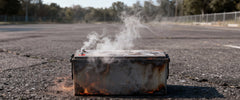
Battery Thermal Runaway 101: How to Stay Safe with Lithium Batteries
, 4 Tiempo mínimo de lectura

, 4 Tiempo mínimo de lectura
Battery thermal runaway is one of the most serious safety risks associated with lithium-ion batteries.
Although rare, it can lead to fires, explosions, toxic gas releases, and severe device damage.
In this guide, you’ll learn:
• What thermal runaway is
• What triggers it
• How to prevent it
• How to respond safely
Quick Tip: Your strongest first layer of protection is using a high-quality battery equipped with a built-in Battery Management System (BMS).
Thermal runaway occurs when a battery’s internal temperature rises uncontrollably. The heat triggers chemical reactions that generate even more heat, creating a self-accelerating chain reaction that may lead to fire or explosion.
Not all lithium batteries behave the same.
LiFePO4 chemistry has a much higher thermal runaway threshold—typically 250°C–300°C—making it one of the safest lithium battery types available.
NMC/NCA lithium-ion cells are more prone to thermal runaway.
| Stage | What Happens | Key Points |
|---|---|---|
| Trigger | Overcharge, overdischarge, internal short circuits, mechanical damage, or high temperature | Initiates the reaction |
| Heat Accumulation | Chemical reactions accelerate, generating increasing heat | Positive feedback begins |
| Self-Acceleration | Temperature rises faster than it can be dissipated | Risk escalates rapidly |
| Combustion / Venting | Flammable gases release; fire or violent rupture may occur | Hazard |
Thermal runaway always begins with a trigger. Causes fall into three main groups:
• Internal Short Circuits: Microscopic metallic particles or aging can create shorts.
• Electrical Abuse: Overcharging causes unstable deposits; overdischarging damages internal structure.
• Cell Degradation: Aging batteries have higher resistance and weaker internal components.
• Thermal Abuse: Leaving batteries in hot vehicles or near heat sources.
• Mechanical Damage: Drops, punctures, or crushes that compromise cell integrity.
• Poor-quality Grade B cells, flawed design, or improper assembly create inherent weaknesses.
Pro Tip: A BMS continuously monitors voltage, temperature, and current and cuts off power before unsafe conditions develop.
Thermal runaway can cause more than just a failed battery:
• Intense Fire: Lithium battery fires burn extremely hot and may reignite.
• Explosion / Venting: Rapid gas buildup may rupture the battery enclosure.
• Toxic Gas Release: Burning electrolyte releases harmful fumes such as hydrogen fluoride (HF) and other irritants.
• Device Destruction: The battery can destroy the device and damage its surroundings.
Reader Alert: Even small batteries—such as those in phones and vapes—can be dangerous if damaged.
Prevention is the most effective strategy. Follow these essential guidelines:
✅ Use certified chargers and compatible batteries — avoid generic or mismatched chargers.
✅ Keep batteries away from heat — avoid direct sunlight, hot cars, heaters, and moisture.
✅ Protect from mechanical stress — prevent drops, punctures, and crushing.
✅ Inspect regularly — look for swelling, leakage, discoloration, or unusual heat.
✅ Install a BMS — especially critical for larger battery packs.
✅ Choose high-quality batteries — select Grade A+ cells and trusted brands.
✅ Replace aging or damaged batteries promptly — don’t push a failing battery past its lifespan.
| Feature | Sunrich Energy 100Ah LiFePO4 Heated Battery |
|---|---|
| Built-in BMS | Protects against overvoltage, overcurrent, short circuits, and high temperature |
| Grade A+ LiFePO4 Cells | Extremely stable chemistry, far less prone to thermal runaway |
| Robust Casing | Mechanical protection against vibration, impact, and puncture |
| Lifespan | Up to 10 years |
| Applications | RVs, vehicles, off-grid systems, marine, portable power |
Why it matters: A properly engineered LiFePO4 battery with BMS protection greatly reduces thermal runaway risk.
If you suspect a battery is entering thermal runaway (hissing, swelling, smoking, or venting), act immediately and safely:
• Use an ABC or CO₂ extinguisher for small fires.
• Sand can help smother very small battery fires.
• Water may be used to cool large lithium-ion battery fires to prevent re-ignition.
• Evacuate the area if smoke is heavy or toxic.
• Call emergency services if the fire cannot be safely controlled.
❌ Do NOT move a swelling, smoking, or burning battery.
❌ Do NOT touch leaking electrolyte — avoid skin contact.
❌ Do NOT use enclosed bins or containers to “smother” a runaway battery.
Wear protective gloves and eyewear when handling a damaged battery that is no longer reacting.
• Thermal runaway is rare, but the consequences can be severe.
• Proper handling, charging, and inspection dramatically reduce risk.
• High-quality LiFePO4 batteries with BMS protection offer the highest safety margin.
Audit your batteries regularly for damage or swelling.
Avoid extreme temperatures, impacts, and overcharging.
Invest in high-quality, BMS-equipped LiFePO4 batteries.
Share battery safety knowledge with your community.
Reminder: Safety starts with awareness—check your batteries today!

$379.99 - $1,443.99

$369.99 - $1,405.99


