
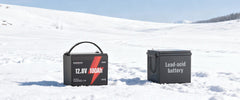
How Cold Weather Affects Lithium and Lead-Acid Batteries
, 4 min reading time

, 4 min reading time
If your RV, solar setup, or boat struggles when temperatures drop, you’re not alone. Cold weather is a major cause of reduced battery performance, shorter runtime, and accelerated aging.
Understanding how low temperatures impact different battery types helps you choose the right battery and stay powered all winter.
2.1 Why Performance Drops
Low temperatures make the electrolyte more viscous, slowing ion movement. This increases internal resistance, reducing both discharge and charge efficiency.
Key Fact: Lithium batteries remain more stable than lead-acid batteries in low temperatures.
2.2 Capacity Reduction
2.3 Low-Temperature Charging Risks
Charging LiFePO₄ batteries below 0°C is unsafe unless the battery includes an active heating system that warms cells above 0°C before charging begins.
Safety Recommendations:
Charging Guide for Lithium Batteries
|
Temperature |
Charging Status |
Recommendation |
|
Above 10°C |
✅ Safe |
Normal charging |
|
0°C to 10°C |
⚠ Conditional |
A built-in heater or external warmer is required |
|
Below 0°C |
❌ Unsafe |
Charging is blocked to prevent damage |
3.1 Significant Performance Drops
3.2 Freezing Risk
3.3 Accelerated Aging
Tip: Keep lead-acid batteries fully charged and insulated during winter. Use heaters or blankets to reduce freeze risk.
|
Feature |
Lithium (LiFePO₄) |
Lead-Acid |
|
Capacity Retention |
Minor drop |
Significant 20–30% drop |
|
Low-Temp Charging |
Possible with the heating system |
High risk of damage |
|
Freeze Risk |
Very low |
High |
|
Lifespan |
Long, low-temp stable |
Short, accelerated aging |
|
Best Environment |
Cold climates |
Not recommended for prolonged cold |
Summary: Lithium batteries outperform lead-acid batteries in nearly all winter performance metrics.
5.1 Lithium Batteries
5.2 Lead-Acid Batteries
For reliable power in any climate, the Sunrich Energy 100Ah Heated LiFePO₄ Battery is engineered to conquer winter.
Tip: For cold regions, a LiFePO₄ battery with built-in heating is the most reliable choice.
Don’t let winter leave you powerless. While all batteries are affected by temperature, Lithium LiFePO₄ batteries with integrated heating systems outperform lead-acid batteries for cold-weather performance.
☛ Ready for a winter-proof power system?
Invest in a Sunrich Energy Heated LiFePO₄ Battery today and enjoy reliable power all winter, whether in your RV, boat, or off-grid solar system.

$379.99 - $1,443.99

$369.99 - $1,405.99


